When patients hear the term “throat cancer,” they often assume it refers to a single disease. In reality, throat cancer is a broad term that includes several different cancers arising in various parts of the throat and voice box. Each type has unique symptoms, risk factors, treatment approaches, and outcomes.
Understanding the different types of throat cancer is important because early recognition of symptoms can lead to earlier diagnosis and more successful treatment.
As a Head & Neck Cancer Surgeon, I frequently meet patients who are unaware that persistent throat symptoms, voice changes, swallowing difficulties, or a neck lump may be signs of throat cancer. In this article, I’ll explain the major types of throat cancer, where they occur, and what symptoms you should never ignore.
What Is Throat Cancer?
The throat is a complex structure that plays a critical role in:
- Breathing
- Swallowing
- Speaking
- Protecting the airway
Throat cancer develops when abnormal cells grow uncontrollably in the tissues of the throat or voice box.
Most throat cancers are classified as squamous cell carcinomas, meaning they originate from the lining cells of the throat.
The main categories of throat cancer include:
- Oropharyngeal cancer
- Hypopharyngeal cancer
- Nasopharyngeal cancer
- Laryngeal cancer
- Tonsil cancer
- Base of tongue cancer
Let’s explore each type in detail.
Understanding the Anatomy of the Throat
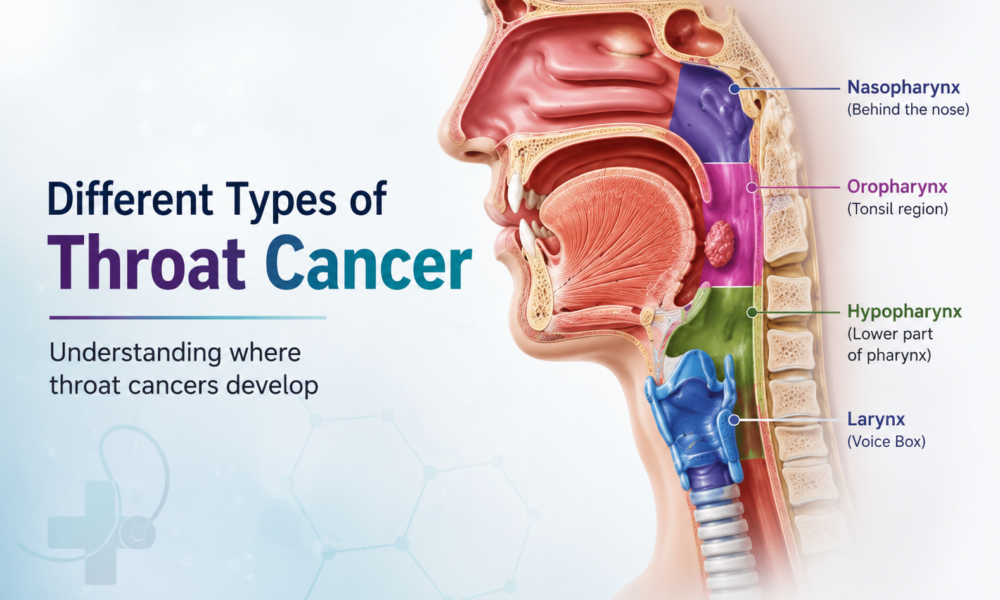
To understand throat cancer, it helps to know the different regions of the throat.
The throat is divided into:
Pharynx
The pharynx is the muscular tube that connects the nose and mouth to the esophagus and voice box.
It consists of:
- Nasopharynx
- Oropharynx
- Hypopharynx
Larynx
The larynx, commonly known as the voice box, contains the vocal cords and helps produce speech.
Cancer can arise in any of these areas.
1. Oropharyngeal Cancer
Oropharyngeal cancer develops in the middle part of the throat, located behind the mouth.
This region includes:
- Tonsils
- Base of the tongue
- Soft palate
- Back wall of the throat
Common Symptoms
- Persistent sore throat
- Difficulty swallowing
- Feeling of something stuck in the throat
- Ear pain
- Neck lump
- Bad breath
- Unexplained weight loss
HPV and Oropharyngeal Cancer
A growing number of oropharyngeal cancers are linked to Human Papillomavirus (HPV) infection.
HPV-related throat cancers often:
- Affect younger patients
- Occur in non-smokers
- Have favorable treatment outcomes when detected early
2. Tonsil Cancer
Tonsil cancer is one of the most common forms of oropharyngeal cancer.
The cancer develops in the tonsillar tissue located on either side of the throat.
Early Symptoms
- One-sided throat pain
- Enlarged tonsil
- Difficulty swallowing
- Neck swelling
- Persistent ear pain
Many patients initially mistake these symptoms for chronic tonsillitis.
Why Early Diagnosis Matters
Because tonsil cancer may spread to neck lymph nodes early, prompt evaluation of persistent symptoms is essential.
3. Base of Tongue Cancer
The base of the tongue refers to the back portion of the tongue located within the throat.
Unlike cancers on the front of the tongue, these tumors are often difficult to see without specialized examination.
Common Symptoms
- Difficulty swallowing
- Foreign body sensation
- Persistent throat discomfort
- Neck lump
- Voice changes
- Ear pain
Many base of tongue cancers are also associated with HPV infection.
4. Hypopharyngeal Cancer
Hypopharyngeal cancer develops in the lower part of the pharynx, just above the esophagus and larynx.
This type of cancer is relatively uncommon but can be aggressive.
Why It Is Often Diagnosed Late
Early-stage hypopharyngeal cancer may produce few symptoms.
As the tumor grows, patients may experience:
- Difficulty swallowing
- Pain while swallowing
- Weight loss
- Persistent throat pain
- Neck lump
- Voice changes
Because symptoms often appear late, regular evaluation of persistent throat complaints is important.
5. Nasopharyngeal Cancer
Nasopharyngeal cancer develops in the uppermost part of the throat behind the nose.
It is less common than other throat cancers and has unique risk factors.
Possible Symptoms
- Nasal blockage
- Frequent nosebleeds
- Hearing loss
- Ear fullness
- Neck lump
- Headaches
Risk Factors
Certain viral infections, genetic factors, and environmental exposures may increase the risk of nasopharyngeal cancer.
6. Laryngeal Cancer (Voice Box Cancer)
Laryngeal cancer affects the voice box, which contains the vocal cords.
This is one of the most recognized forms of throat cancer because it often causes early voice symptoms.
The larynx is divided into:
Supraglottic Region
Located above the vocal cords.
Glottic Region
Contains the vocal cords.
Subglottic Region
Located below the vocal cords.
Common Symptoms
- Persistent hoarseness
- Voice changes
- Difficulty swallowing
- Chronic cough
- Breathing difficulty
- Throat pain
Why Hoarseness Should Never Be Ignored
A voice change lasting longer than two weeks deserves evaluation by a specialist, particularly in individuals with risk factors such as tobacco use.
How Do the Symptoms Differ Between Types?
While symptoms may overlap, some signs are more strongly associated with specific cancers.
| Cancer Type | Common Early Symptom |
| Tonsil Cancer | One-sided throat pain, neck lump |
| Base of Tongue Cancer | Swallowing difficulty |
| Oropharyngeal Cancer | Neck swelling |
| Laryngeal Cancer | Persistent hoarseness |
| Nasopharyngeal Cancer | Nasal blockage, ear symptoms |
| Hypopharyngeal Cancer | Progressive swallowing difficulty |
Understanding these differences can help patients seek medical attention earlier.
Risk Factors for Throat Cancer
Several factors increase the risk of developing throat cancer.
Tobacco Use
Smoking and smokeless tobacco remain major risk factors.
Alcohol Consumption
Heavy alcohol use increases risk, particularly when combined with tobacco.
HPV Infection
HPV-related throat cancers are increasing worldwide.
Poor Oral Hygiene
Chronic irritation and poor dental health may contribute to cancer development.
Environmental Exposure
Long-term exposure to industrial chemicals, dust, and pollution may increase risk.
Family History
A family history of head and neck cancer may increase susceptibility in some individuals.
How Is Throat Cancer Diagnosed?
If throat cancer is suspected, evaluation may include:
Clinical Examination
Detailed examination of the mouth, throat, and neck.
Endoscopy
Flexible endoscopy allows direct visualization of areas deep within the throat.
Imaging Studies
- CT Scan
- MRI Scan
- PET-CT Scan
These help determine the extent of disease.
Biopsy
A biopsy remains the gold standard for confirming cancer.
Treatment Options for Throat Cancer
Treatment depends on:
- Cancer type
- Stage
- Location
- Overall health
Common treatment approaches include:
Surgery
Modern surgery aims to remove cancer while preserving speech and swallowing function.
Radiation Therapy
Often used alone or after surgery.
Chemotherapy
Typically used for advanced cancers or combined with radiation.
Robotic Surgery
Selected throat cancers can be treated using minimally invasive robotic techniques, reducing recovery time and improving functional outcomes.
Can Throat Cancer Be Cured?
Yes. Many throat cancers are highly treatable, particularly when diagnosed early.
Early-stage cancers often have:
- Better cure rates
- Less intensive treatment
- Better preservation of speech and swallowing
The key is not ignoring persistent symptoms.
When Should You See a Specialist?
You should seek medical evaluation if you experience:
- Hoarseness lasting more than two weeks
- Persistent sore throat
- Difficulty swallowing
- Neck lump
- Ear pain without infection
- Unexplained weight loss
Early diagnosis can make a significant difference in treatment success and quality of life.
Final Thoughts
Throat cancer is not a single disease but a group of cancers that can arise in different parts of the throat, including the pharynx, larynx, tonsils, and base of the tongue. Each type has distinct symptoms and treatment considerations, but all share one important fact: early detection saves lives.
Persistent throat symptoms should never be ignored. If something feels unusual and does not improve within a few weeks, consult a specialist for a thorough evaluation. Modern advances in surgery, radiation therapy, and cancer care have made successful treatment possible for many patients, particularly when cancer is identified at an early stage.
About the Author
Dr. Dushyant Mandlik is a Top Head & Neck Cancer Surgeon in ahmedabad specializing in the diagnosis and treatment of oral cancer, throat cancer, thyroid cancer, salivary gland tumors, and complex head and neck conditions. With expertise in advanced surgical oncology, microvascular reconstruction, and minimally invasive procedures, he is committed to providing comprehensive, patient-centered cancer care. Through education and awareness initiatives, Dr. Mandlik helps patients understand their conditions and seek timely treatment for the best possible outcomes.