Medical science advances when we are willing to question established approaches, examine emerging evidence, and discuss where new treatments may fit into clinical practice.
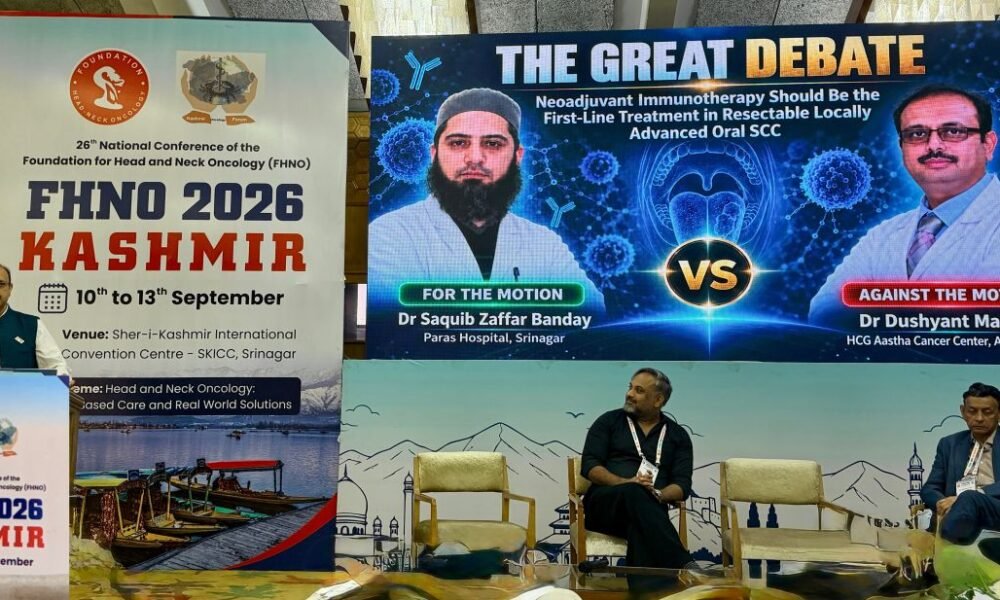
At FHNO 2026 in Srinagar, I had the opportunity to participate in an engaging academic debate on an increasingly relevant question in Head & Neck Oncology:
“Neoadjuvant Immunotherapy Should Be the First-Line Treatment in Resectable Locally Advanced Oral Squamous Cell Carcinoma.”
I had the opportunity to speak against the motion, while Dr. Saquib Zaffar Banday presented the case for the motion.
The session was moderated by Dr. Subramania Iyer and Dr. Rakesh MP, making it an engaging exchange of evidence, perspectives, clinical experience and scientific reasoning.
Why Is This Question Important?
Immunotherapy has changed the treatment landscape for several cancers, including head and neck cancers. The growing interest in using immunotherapy before surgery known as neoadjuvant immunotherapy, raises important questions about how it may fit into the treatment of resectable locally advanced oral squamous cell carcinoma.
The potential rationale is compelling: treating the tumor before definitive surgery may influence the tumor’s immune environment and could potentially provide valuable information about how an individual cancer responds to treatment.
At the same time, introducing a new treatment strategy into routine practice requires careful consideration of the available evidence.
The key question is not simply whether a treatment is promising.
It is:
Is the evidence sufficiently mature to change the standard approach for every appropriate patient?
The Importance of Evidence
In head and neck oncology, treatment decisions have significant consequences.
For patients with resectable locally advanced oral cancer, surgery remains an important component of treatment. Decisions regarding the timing and sequence of surgery, systemic therapy and radiation need to consider oncological safety, functional outcomes and the individual characteristics of the disease.
Neoadjuvant immunotherapy is an evolving area of research. Clinical trials and emerging data are helping us understand which patients may benefit, which biomarkers may be relevant, and how immunotherapy should potentially be integrated with surgery and other treatments.
But promising early results need to be interpreted carefully.
A new approach should ultimately demonstrate meaningful benefits in outcomes that matter to patients before it becomes routine practice.
The Value of Academic Debate
This was what made the debate particularly valuable.
A structured debate allows clinicians to examine the same evidence from different perspectives.
It encourages us to ask:
- What does the current evidence actually demonstrate?
- Which findings are supported by mature clinical data?
- Which questions remain unanswered?
- Which patients may benefit?
- What are the potential risks of changing treatment sequencing?
- When should emerging evidence become everyday clinical practice?
These discussions are essential in a rapidly evolving specialty.
The purpose of a debate is not simply to determine who wins an argument. Its real value lies in critical examination of evidence and assumptions.
From Evidence to Clinical Practice
There is often a journey between an interesting research finding and a change in routine clinical practice.
That journey requires carefully conducted clinical trials, reproducible results, appropriate patient selection and meaningful clinical endpoints.
For surgeons and oncologists, it also requires consideration of practical questions.
Will introducing a treatment before surgery delay definitive treatment?
Could treatment response help identify patients who may benefit from a different strategy?
Can immunotherapy improve long-term oncological outcomes?
What are the implications for surgery after neoadjuvant treatment?
How should treatment be integrated with postoperative radiation or systemic therapy?
These are precisely the kinds of questions that need continued research and multidisciplinary discussion.
Learning Through Disagreement
One of the most valuable aspects of academic medicine is that disagreement does not necessarily represent division.
A well-structured disagreement can be productive when both sides are grounded in evidence and focused on improving patient care.
The discussion at FHNO 2026 was a good example of this.
Presenting different viewpoints encouraged deeper examination of the available evidence and allowed us to challenge our own assumptions.
That process debate, discussion, challenge and evolution, is an essential part of medical progress.
Looking Ahead
The role of immunotherapy in oral squamous cell carcinoma will continue to evolve as more clinical evidence becomes available.
As clinicians, our responsibility is to remain open to innovation while maintaining scientific discipline.
We should neither reject promising advances prematurely nor adopt them before the evidence supports their routine use.
Ultimately, every treatment decision should remain centred on the individual patient, the biology and stage of the cancer, the available evidence, and the potential balance between benefit and risk.
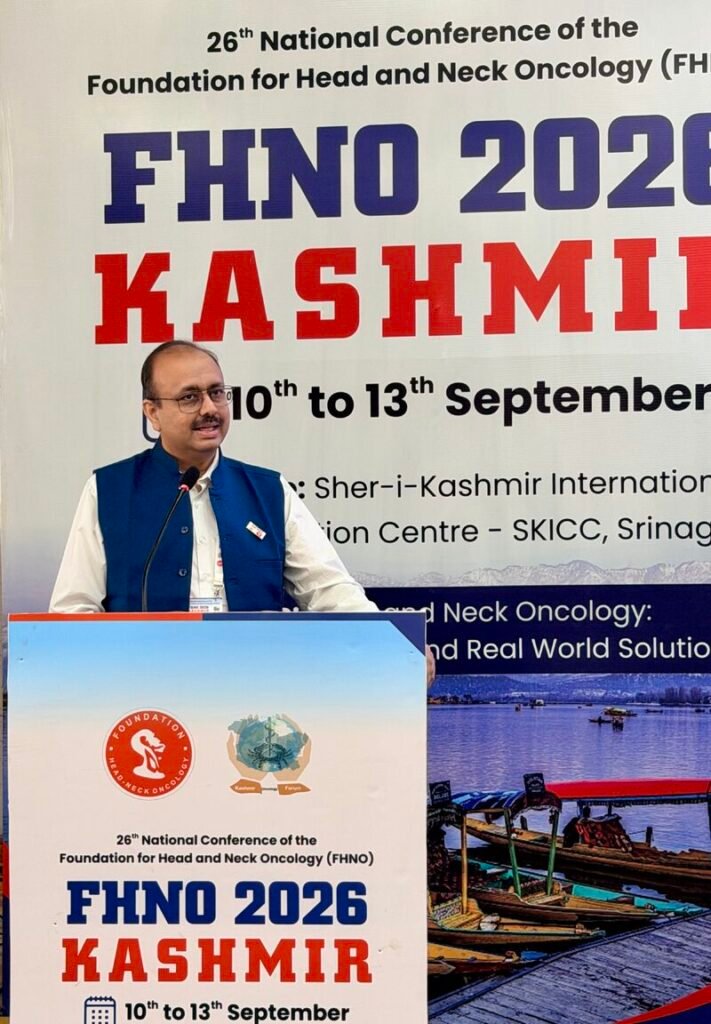
I thoroughly enjoyed the academic exchange, rebuttal and discussion at FHNO 2026.
My sincere thanks to Dr. Azhar Batoo, the entire Team FHNO 2026, and the Foundation for Head and Neck Oncology (FHNO) for creating such a vibrant academic platform in Srinagar.
Good medicine evolves through evidence.
Good academic medicine evolves through discussion.