Receiving a diagnosis of oral cancer can be overwhelming for patients and their families. One of the first questions most patients ask is, “What are my treatment options?” The good news is that advances in cancer care have significantly improved treatment outcomes, especially when oral cancer is diagnosed early.
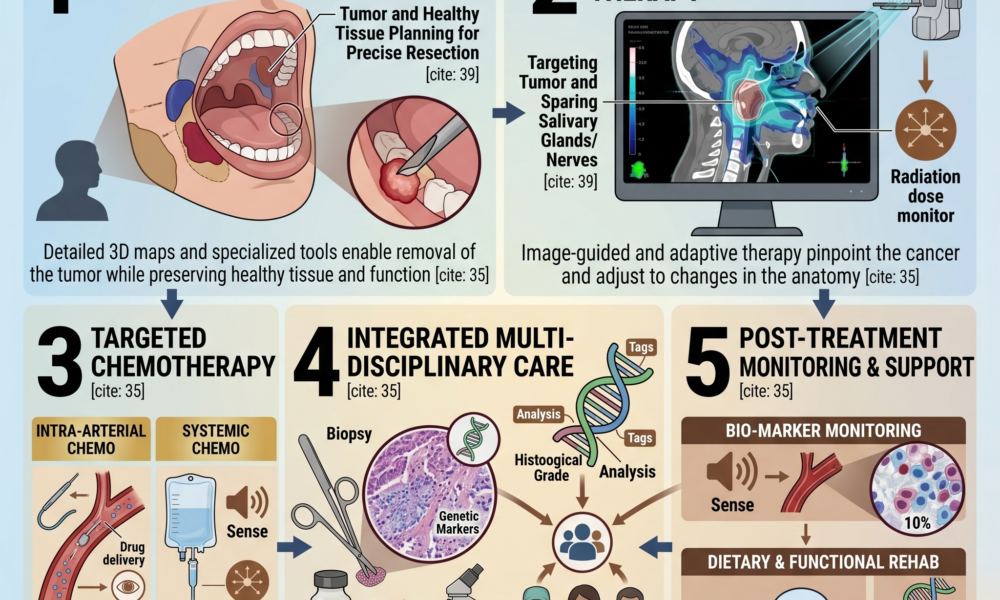
Modern oral cancer treatment is highly personalized. Depending on the stage, location, size of the tumor, and the patient’s overall health, treatment may involve surgery, radiation therapy, chemotherapy, or a combination of these approaches.
As a Head & Neck Cancer Surgeon, I often explain to patients that successful treatment is not about choosing a single therapy—it’s about selecting the most appropriate treatment plan to achieve the best possible cancer control while preserving speech, swallowing, appearance, and quality of life.
In this article, we’ll explore the main treatment options available for oral cancer and how treatment decisions are made.
Understanding Oral Cancer
Oral cancer refers to cancer that develops in the mouth, including the:
- Tongue
- Gums
- Floor of the mouth
- Inner lining of the cheeks
- Hard palate
- Lips
The majority of oral cancers are classified as squamous cell carcinomas, which arise from the cells lining the oral cavity.
Treatment recommendations depend on several factors, including:
- Cancer stage
- Tumor size and location
- Involvement of lymph nodes
- Whether cancer has spread
- Patient’s age and overall health
Surgery: The Primary Treatment for Most Oral Cancers
For many patients, surgery is the cornerstone of oral cancer treatment.
The primary goal of surgery is to completely remove the cancer while preserving as much normal tissue and function as possible.
When Is Surgery Recommended?
Surgery is commonly recommended for:
- Early-stage oral cancer
- Localized tumors
- Resectable advanced cancers
- Recurrent oral cancers in selected patients
What Happens During Oral Cancer Surgery?
The procedure varies depending on the tumor’s size and location.
Surgery may involve:
- Removal of the primary tumor
- Removal of surrounding healthy tissue (surgical margin)
- Removal of affected lymph nodes in the neck (neck dissection)
The objective is to ensure complete cancer removal while minimizing functional impairment.
Neck Dissection
Even when cancer is visible only inside the mouth, microscopic cancer cells may spread to neck lymph nodes.
A neck dissection may be recommended to:
- Remove cancerous lymph nodes
- Reduce recurrence risk
- Improve long-term outcomes
Reconstructive Surgery
Modern oral cancer surgery often includes reconstruction to restore appearance and function.
Advanced techniques such as microvascular free flap reconstruction allow surgeons to rebuild tissues using bone, skin, or soft tissue from other parts of the body.
Reconstruction can help patients:
- Speak more clearly
- Swallow more effectively
- Maintain facial symmetry
- Improve overall quality of life
Advantages of Surgery
- Immediate tumor removal
- Accurate pathological assessment
- High cure rates in early-stage disease
- Effective local cancer control
Radiation Therapy
Radiation therapy uses high-energy beams to destroy cancer cells.
It may be used:
- After surgery
- As the primary treatment in selected cases
- Along with chemotherapy
- For recurrent disease
When Is Radiation Recommended?
Radiation therapy is commonly advised when:
- Cancer is advanced
- Surgical margins are close or positive
- Multiple lymph nodes are involved
- Cancer has spread outside lymph nodes
- Surgery is not feasible
How Radiation Therapy Works
Treatment is delivered over several weeks using advanced machines that precisely target cancer cells while minimizing damage to healthy tissue.
Modern techniques such as:
- Intensity-Modulated Radiation Therapy (IMRT)
- Image-Guided Radiation Therapy (IGRT)
allow for highly accurate treatment delivery.
Benefits of Radiation Therapy
- Preserves surrounding structures
- Effective against microscopic disease
- Reduces recurrence risk
- Can be combined with other treatments
Possible Side Effects
Patients may experience:
- Mouth dryness
- Difficulty swallowing
- Taste changes
- Mouth ulcers
- Skin irritation
Most side effects can be effectively managed with supportive care.
Chemotherapy
Chemotherapy uses medications to destroy cancer cells throughout the body.
Unlike surgery and radiation, chemotherapy is considered a systemic treatment because it circulates through the bloodstream.
When Is Chemotherapy Used?
Chemotherapy may be recommended:
- Along with radiation therapy
- For advanced-stage cancers
- For recurrent disease
- When cancer has spread to distant organs
Chemoradiation
One of the most common approaches in advanced oral cancer is concurrent chemoradiation, where chemotherapy and radiation are administered together.
Chemotherapy enhances the effectiveness of radiation and improves cancer control in selected patients.
Common Chemotherapy Drugs
The treatment regimen varies depending on the patient’s condition and cancer characteristics.
Drugs may be administered:
- Intravenously
- In cycles
- Over several weeks
Possible Side Effects
Side effects may include:
- Fatigue
- Nausea
- Reduced immunity
- Hair thinning
- Loss of appetite
Fortunately, modern supportive treatments have made chemotherapy much more manageable than in the past.
Targeted Therapy and Immunotherapy
In selected cases, newer treatments may be considered.
Targeted Therapy
Targeted therapies focus on specific molecules that help cancer grow.
These treatments may be used:
- In recurrent disease
- In advanced cancers
- When conventional treatment options are limited
Immunotherapy
Immunotherapy helps the body’s immune system recognize and attack cancer cells.
It has shown promising results in some advanced or recurrent head and neck cancers.
While not suitable for every patient, these therapies have expanded treatment possibilities significantly.
How Doctors Choose the Right Treatment
There is no one-size-fits-all treatment plan for oral cancer.
Treatment decisions are based on:
- Cancer stage
- Tumor location
- Pathology findings
- Lymph node involvement
- Patient’s medical condition
- Functional considerations
Most patients benefit from evaluation by a multidisciplinary team that may include:
- Head & Neck Surgeons
- Radiation Oncologists
- Medical Oncologists
- Radiologists
- Pathologists
- Rehabilitation Specialists
This collaborative approach ensures comprehensive care.
What Happens After Treatment?
Cancer treatment does not end when surgery, radiation, or chemotherapy is completed.
Follow-up care is essential to:
- Monitor recovery
- Detect recurrence early
- Manage treatment-related side effects
- Support speech and swallowing rehabilitation
Patients are encouraged to attend regular follow-up appointments and maintain healthy lifestyle habits.
Can Oral Cancer Be Cured?
Yes. Many patients with oral cancer can be successfully treated, particularly when the disease is diagnosed early.
Early-stage oral cancers often have excellent outcomes with surgery alone, while advanced cancers can frequently be controlled through a combination of surgery, radiation therapy, and chemotherapy.
The key is early detection and timely treatment.
Final Thoughts
Oral cancer treatment has evolved tremendously over the years. Today, patients benefit from advanced surgical techniques, precision radiation therapy, effective chemotherapy protocols, and innovative targeted treatments.
The best treatment plan depends on the individual patient and the characteristics of the cancer. As a Head & Neck Cancer Surgeon, my goal is not only to remove the cancer but also to preserve essential functions such as speaking, swallowing, breathing, and overall quality of life.
If you notice a persistent mouth ulcer, unexplained lump, difficulty swallowing, or any unusual changes in your oral cavity that last more than two weeks, seek medical evaluation promptly. Early diagnosis remains the most important factor in achieving successful outcomes.
About the Author
Dr. Dushyant Mandlik is a Head & Neck Cancer Specialist in Ahmedabad specializing in oral cancer, thyroid cancer, salivary gland tumors, vascular tumors, and complex reconstructive surgery. With extensive experience in advanced cancer surgery and microvascular reconstruction, he is committed to providing personalized, evidence-based care that prioritizes both cancer control and quality of life. Through patient education and awareness initiatives, Dr. Mandlik aims to promote early detection and better treatment outcomes for head and neck cancers.