There are some professional meetings that leave you with a notebook full of information. Others leave you with ideas that continue to influence the way you think long after the meeting has ended.
IFHNOS 2026 in Brisbane was one of those experiences for me.
It was a privilege to participate as an invited faculty member and speaker at the 8th World Congress of the International Federation of Head and Neck Oncologic Societies (IFHNOS), held in Brisbane, Australia. The Congress brought together clinicians, researchers and allied health professionals from across the world to exchange knowledge and discuss the evolving landscape of head and neck oncology.
For me, however, the value of the meeting extended well beyond the scientific sessions.
It was about people, conversations, perspectives and the opportunity to reflect on how we can continue to improve the care we provide to our patients.
A Global Perspective on Head & Neck Cancer Care
Head and neck oncology is a field that continues to evolve rapidly.
Advances in surgery, reconstruction, radiation oncology, systemic therapy, immunotherapy, imaging, molecular diagnostics and rehabilitation are changing the way we approach patients. But with this progress comes an equally important responsibility—to determine how these advances should be integrated into real-world clinical practice.
Meetings such as IFHNOS provide an opportunity to step outside our individual institutional environments and look at these questions from a much broader perspective.
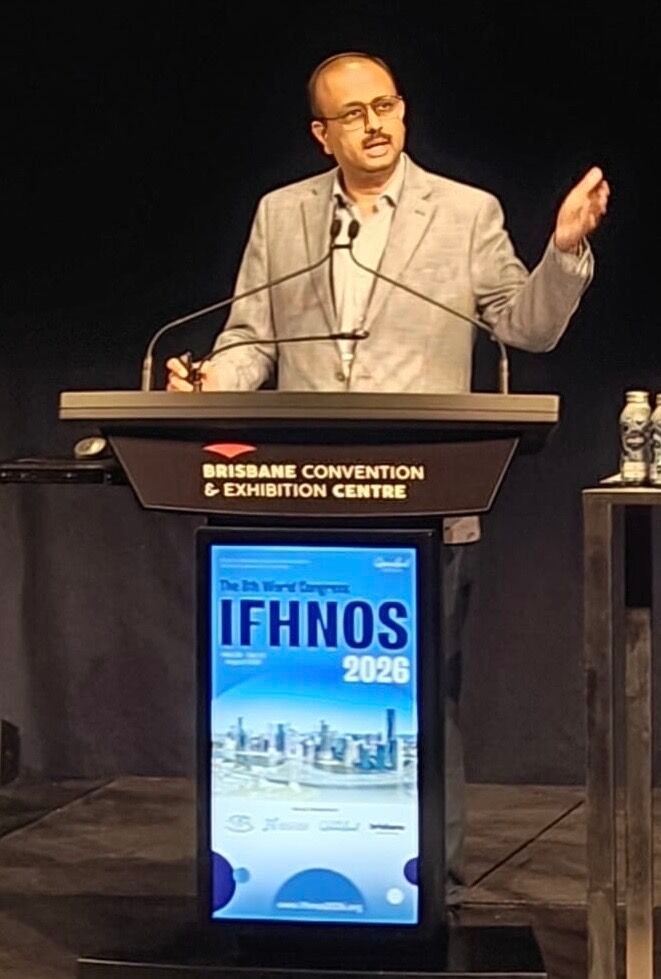
The 2026 Congress was built around the idea of global harmonisation of head and neck cancer care through international collaboration, bringing together expertise from different healthcare systems and different parts of the world.
That diversity of experience is extremely valuable.
What may be routine practice in one part of the world may be an emerging concept somewhere else. Different institutions may approach the same clinical problem differently. Discussing these differences openly helps us question our assumptions and identify opportunities to improve.
Beyond the Scientific Sessions
As surgeons and clinicians, our schedules often leave limited time for extended academic conversations.
A major international meeting creates a rare opportunity to pause and discuss cases, techniques, research and clinical challenges with colleagues who share the same commitment to the specialty.
Some of the most meaningful discussions happen outside the formal lecture hall.
A conversation over coffee.
A discussion after a presentation.
An exchange of experiences about a challenging case.
A debate about the advantages and limitations of a particular treatment strategy.
These interactions may not appear in a conference programme, but they are often where new ideas begin.
For me, this was one of the most rewarding aspects of IFHNOS 2026.
Meeting Professor Sandro Porceddu
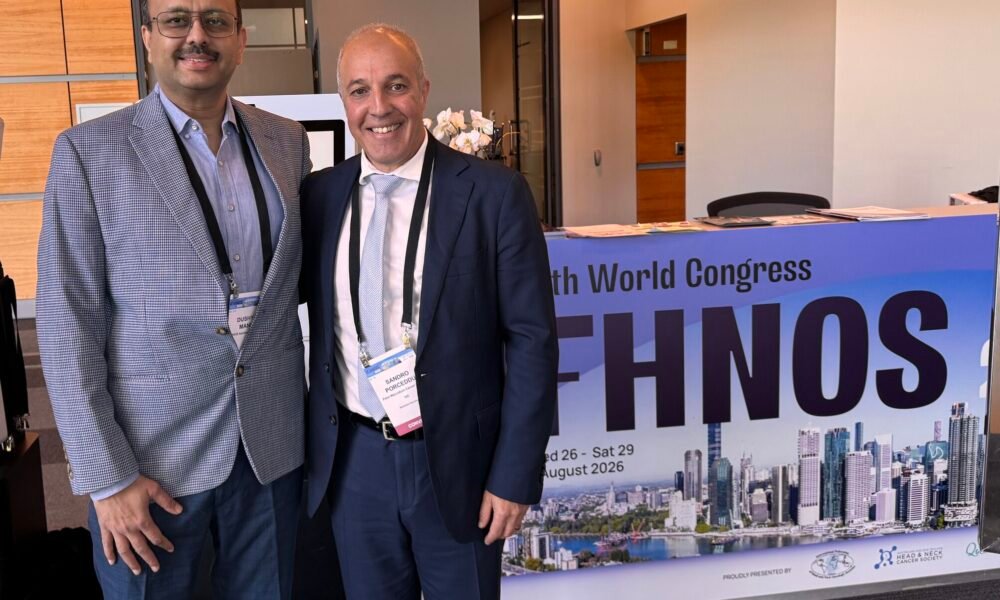
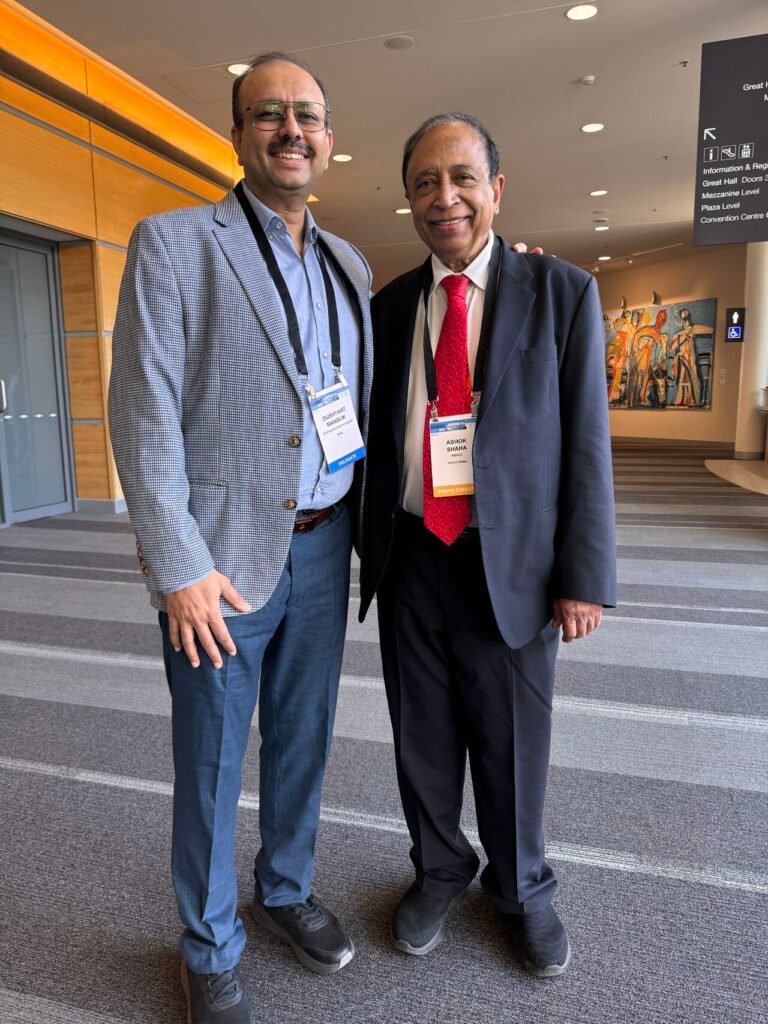
It was a pleasure to meet and interact with Professor Sandro V. Porceddu, Convenor of IFHNOS 2026.
Professor Porceddu’s leadership brought together an outstanding international academic programme and a remarkable group of experts in head and neck oncology. He is internationally recognised for his work in radiation oncology and head and neck cancer, and has extensive experience spanning clinical practice, research and academic leadership.
The scale and diversity of the Brisbane meeting reflected the collaborative effort behind it.
The Congress brought together more than 200 speakers from around the world, representing disciplines including surgery, radiation oncology, medical oncology, radiology, pathology, immunology, rehabilitation and palliative care.
That multidisciplinary representation is particularly important in head and neck cancer, where treatment decisions rarely belong to a single specialty.
The Most Rewarding Part: Seeing the Next Generation
One of the most satisfying aspects of the meeting was seeing young colleagues whom I have had the opportunity to know through fellowship training actively participate on an international academic platform.
It was particularly heartening to see Dr. Bhavya Mishra and Dr. Shreya Rai, both FIIF alumni, contributing to the programme.
For those of us involved in fellowship training, there is perhaps no greater satisfaction than seeing younger colleagues progress from learners to confident clinicians, researchers and academic contributors.
Training is not simply about transferring technical knowledge.
It is about encouraging curiosity, developing independent thinking, teaching the importance of evidence, and creating the confidence to ask difficult questions.
Ultimately, the success of an educational programme should be measured not only by what the trainees learn from us, but also by what they go on to contribute to the specialty.
Seeing former fellows participate at a global meeting was therefore a particularly meaningful moment for me.
A Strong Academic Presence from HCG Aastha Cancer Centre
Another source of pride was seeing strong representation from HCG Aastha Cancer Centre at the Congress.
Five invited faculty from our institution contributed to IFHNOS 2026:
- Dr. Dushyant Mandlik
- Dr. Kaustubh Patel
- Dr. Rajendra Toprani
- Dr. Aditya Joshipura
- Dr. Kshitij Domadia
Having multiple faculty members invited to contribute to an international head and neck oncology meeting is a reflection of the academic culture that has developed within the institution.
But more importantly, it represents a collective commitment to continuously learning, teaching and contributing to the wider head and neck oncology community.
Academic growth does not happen through individual effort alone.
It comes from an environment where clinical experience, research, teaching and collaboration are encouraged.
What Do We Bring Back From a Meeting Like This?
The most important outcome of a conference is not the number of lectures attended.
It is what happens after returning home.
Which ideas should influence our clinical practice?
Which techniques deserve further evaluation?
Which research questions remain unanswered?
What can we teach our trainees?
Where can collaboration help us generate better evidence?
And, ultimately, how can all of this translate into better outcomes for patients?
These are the questions I find myself reflecting on after Brisbane.
Modern head and neck oncology is increasingly moving towards personalised and multidisciplinary treatment. At the same time, we must remain conscious that technological advancement should always serve a larger purpose.
The patient remains at the centre of every decision.
A technically sophisticated procedure is valuable only when it improves cancer control, function, quality of life, or the overall patient experience.
This patient-centred perspective was also strongly reflected in the scientific programme. Professor Porceddu’s Chris O’Brien Oration, for example, focused specifically on the prioritisation of patient-centred radiation therapy in head and neck cancer.
Collaboration Is the Way Forward
Head and neck cancer does not recognise geographical boundaries.
Neither should our academic collaboration.
International meetings such as IFHNOS create opportunities to establish professional relationships that can develop into research collaborations, educational initiatives, fellowship opportunities and shared learning.
For a relatively specialised field such as head and neck oncology, these networks are particularly valuable.
We learn from colleagues who encounter different disease patterns.
We learn from institutions with different resources and treatment pathways.
We learn from researchers working on questions that may eventually change clinical practice.
And we learn from younger colleagues who bring new perspectives and different ways of approaching familiar problems.
Returning to Practice With New Questions
I returned from Brisbane with a sense of being enriched—not simply by the information presented, but by the conversations and perspectives exchanged over those few days.
There are new ideas to explore, new academic discussions to continue and several thoughts that I hope will translate into our clinical and educational work.
Conferences eventually end.
The presentations are archived, the delegates return home, and the meeting halls become quiet again.
But the conversations, collaborations and ideas generated during these meetings continue.
That, to me, is the real value of an international academic gathering.
Looking Ahead
As head and neck cancer surgeons, our responsibility extends beyond performing surgery.
We have a responsibility to keep learning.
To question established practices.
To evaluate new evidence critically.
To teach the next generation.
To collaborate across disciplines and borders.
And most importantly, to ensure that every advancement in science and technology ultimately benefits the patient sitting in front of us.
IFHNOS 2026 in Brisbane reminded me once again that progress in head and neck oncology is not the work of one surgeon, one institution, or one country. It is built through collective knowledge, open discussion and a shared commitment to better patient care.
I return from Brisbane grateful for the opportunity to have contributed, inspired by the colleagues I met, proud of the young clinicians continuing their academic journey, and motivated to carry these conversations forward.
The meeting may be over.
The work continues.