When treating head and neck cancer, the first priority is always complete and safe removal of the cancer. But cancer surgery does not end with tumor removal. In many patients, particularly those with larger or advanced tumors, removing the cancer can leave a defect involving the tongue, jaw, throat, face, skin, or other important structures.
This is where reconstructive head and neck surgery becomes an important part of comprehensive head and neck cancer treatment.
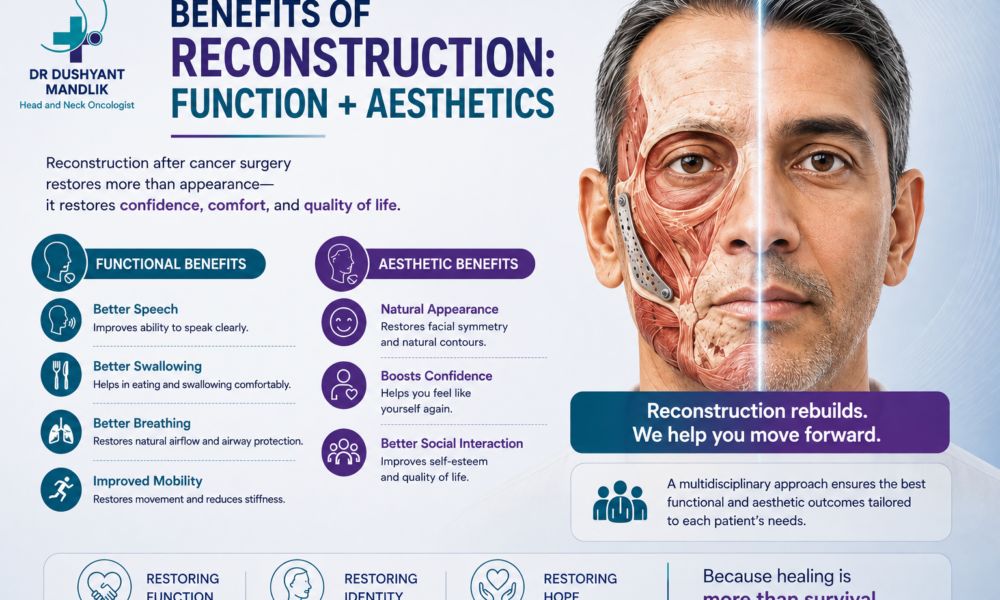
With more than 20 years of experience in head and neck cancer surgery, I believe that successful cancer treatment should aim for more than disease control. Whenever reconstruction is required, our objective should also be to help the patient speak, swallow, chew, breathe, interact socially, and feel comfortable with their appearance.
Modern reconstructive techniques,including local and regional flaps, microvascular free flaps, and bone reconstruction,allow us to restore both function and aesthetics after cancer surgery.
What Is Reconstruction in Head & Neck Cancer Surgery?
Reconstruction is the process of rebuilding tissues that have been removed or damaged during cancer surgery.
Depending on the location and size of the defect, reconstruction may involve:
- Skin and soft tissue
- Muscle
- Bone
- Mucosal lining
- Blood vessels
- A combination of these tissues
In some patients, reconstruction is relatively simple. In others, particularly after extensive oral cavity, jaw, tongue, or throat cancer surgery, a microvascular free flap may be required.
During free-flap reconstruction, tissue is transferred from another part of the patient’s body and its small arteries and veins are connected to blood vessels in the head and neck under a microscope.
The reconstructive technique is selected according to the defect,not simply according to the availability of a particular flap.
Why Is Reconstruction Important?
A head and neck cancer defect can affect much more than appearance.
The structures of the head and neck perform several essential functions. The tongue helps with speech and swallowing. The jaw is essential for chewing and facial contour. The palate separates the oral and nasal cavities. The throat plays an important role in swallowing and speech.
When these structures are significantly affected by cancer surgery, reconstruction can help restore their function.
The National Cancer Institute also emphasizes that preserving function and supporting rehabilitation are important goals of head and neck cancer treatment.
1. Restoration of Swallowing
One of the most important benefits of reconstruction is helping patients regain the ability to eat and drink.
Extensive surgery involving the tongue, floor of mouth, jaw, or throat can interfere with:
- Food preparation
- Tongue movement
- Bolus control
- Chewing
- Swallowing
Appropriate reconstruction can provide the tissue volume and shape needed to support these functions.
However, reconstruction alone does not guarantee normal swallowing. Recovery also depends on the extent of the cancer, the structures removed, radiation treatment, neurological function, and rehabilitation.
Speech and swallowing therapy are therefore an integral part of recovery.
2. Better Speech and Communication
The tongue, palate, teeth, jaw, and throat work together to produce clear speech.
Removal of a significant portion of the tongue or palate can alter articulation and resonance. Reconstruction aims to create an appropriate anatomical structure that allows the remaining muscles and tissues to function as effectively as possible.
Patients may still require speech therapy after surgery, but a well-planned reconstruction can provide a better foundation for rehabilitation.
The goal is not merely to close the surgical defect,it is to reconstruct tissue in a way that supports function.
3. Restoration of Chewing
The jaw and teeth are essential for effective mastication.
Some oral cancers require removal of a portion of the mandible or maxilla. Without reconstruction, patients may experience significant difficulty with chewing and may also develop changes in facial contour.
For selected patients requiring mandibular reconstruction, a fibula free flap can provide bone that can be shaped to reconstruct the jaw.
In suitable cases, dental rehabilitation can subsequently be considered to improve chewing function.
4. Restoration of Facial Contour
The face is central to identity and social interaction.
Removal of a tumor can sometimes result in:
- Loss of facial volume
- Jaw asymmetry
- Changes in the lower face
- Skin or soft-tissue defects
- Changes around the nose or cheek
Reconstruction aims to restore the three-dimensional contour of the face as closely as possible.
This is particularly important in areas that are visible during normal conversation and social interaction.
5. Improving Aesthetic Outcomes
Aesthetic reconstruction is not simply about making a surgical scar look better.
It involves restoring:
- Facial symmetry
- Tissue volume
- Skin contour
- Jawline
- Oral and facial proportions
Research has shown that appearance can influence psychosocial functioning in patients undergoing head and neck cancer reconstruction. Aesthetic outcomes should therefore be considered as part of comprehensive cancer care rather than as an optional cosmetic concern.
At the same time, expectations must remain realistic. Reconstruction aims to restore the best possible appearance and function,it does not necessarily recreate exactly what was present before cancer surgery.
6. Supporting Breathing and Airway Function
Certain head and neck cancers can affect structures involved in maintaining the airway.
Reconstruction may help restore appropriate anatomy after tumor removal, depending on the surgical site.
For patients undergoing major laryngeal or airway procedures, rehabilitation and appropriate postoperative management are especially important.
The exact reconstructive approach depends on the cancer and the structures that need to be removed.
7. Helping Patients Return to Normal Activities
Successful reconstruction can make everyday activities easier.
These may include:
- Eating with family
- Speaking at work
- Participating in social situations
- Returning to professional activities
- Maintaining personal relationships
Quality of life after head and neck cancer is influenced by multiple factors, including swallowing, speech, treatment-related effects, and psychosocial wellbeing. Evidence from systematic reviews supports the importance of considering these factors when planning reconstruction and rehabilitation.
8. Reconstruction Can Support Rehabilitation
Reconstruction and rehabilitation should not be considered two separate processes.
They work together.
Depending on the patient’s needs, rehabilitation may include:
- Speech therapy
- Swallowing therapy
- Physiotherapy
- Nutritional support
- Dental rehabilitation
- Occupational therapy
The National Cancer Institute identifies speech therapy, dietary support, physical therapy, and other rehabilitation services as important components of recovery for patients with head and neck cancer.
A reconstructive plan should therefore be designed with the patient’s expected rehabilitation in mind.
Common Reconstructive Options
There is no single reconstructive technique that is best for every patient.
Local and Regional Flaps
For smaller or appropriately located defects, tissue from nearby areas may be used.
These procedures can provide reliable coverage without requiring a free flap.
Radial Forearm Free Flap
This provides thin, pliable tissue and can be particularly useful for reconstruction of the tongue, floor of mouth, and other soft-tissue defects.
Anterolateral Thigh Free Flap
The ALT flap provides versatile soft tissue and can be customized according to the size and depth of the defect.
Fibula Free Flap
When part of the jaw needs to be removed, the fibula can provide bone for mandibular reconstruction. In selected patients, this can also facilitate subsequent dental rehabilitation.
Other Free Flaps
Depending on the defect, tissues from the scapula, thigh, abdomen, or other donor sites may be considered.
The choice depends on the patient’s anatomy, defect, previous treatment, medical condition, and functional goals.
Reconstruction and Radiation Therapy
Many patients with advanced head and neck cancer require postoperative radiation therapy, sometimes with chemotherapy.
Radiation can affect wound healing, tissue quality, swallowing, and long-term function. Therefore, reconstructive planning needs to take the possibility of adjuvant treatment into account from the beginning.
This is one reason why reconstruction is best planned as part of the overall cancer treatment strategy, rather than as an isolated operation.
Does Every Patient Need Reconstruction?
No. Some cancer operations result in relatively small defects that heal naturally or require only simple closure.
Reconstruction is considered when the expected defect could significantly affect:
- Function
- Facial appearance
- Oral competence
- Swallowing
- Speech
- Structural stability
The decision is individualized after considering both the cancer and the patient’s goals.
Choosing Reconstruction: Function Before Appearance
One important principle I follow is that function and cancer control must come before aesthetics.
A beautiful reconstruction that does not allow the patient to swallow or speak effectively is not a successful reconstruction.
Similarly, reconstruction should never compromise adequate cancer removal.
The ideal result is a balance between:
Cancer control + functional restoration + aesthetic restoration + quality of life.
For patients considering treatment, discussing reconstructive options with an experienced head and neck cancer surgeon in Ahmedabad can help in planning cancer surgery and reconstruction together.
What Happens After Reconstruction?
Recovery takes time.
Immediately after surgery, the priority is monitoring the reconstructed tissue and managing pain, nutrition, wounds, and other medical needs.
As healing progresses, rehabilitation becomes increasingly important.
Patients may gradually work on:
- Oral intake
- Swallowing
- Speech
- Jaw movement
- Neck and shoulder mobility
- Physical strength
- Dental function
Recovery varies considerably from one patient to another. Factors such as tumor stage, extent of surgery, radiation therapy, nutritional status, age, and complications can influence the rehabilitation journey.
The Importance of a Multidisciplinary Team
Complex head and neck cancer reconstruction is rarely the work of one person.
Depending on the case, treatment may involve:
- Head and neck cancer surgeon
- Reconstructive/microvascular surgeon
- Radiation oncologist
- Medical oncologist
- Radiologist
- Pathologist
- Dentist or maxillofacial rehabilitation specialist
- Speech and swallowing therapist
- Nutritionist
- Physiotherapist
This multidisciplinary approach allows cancer treatment and reconstruction to be planned together.
Specialized head and neck cancer centers increasingly combine reconstructive surgery with speech, swallowing, physiotherapy, nutritional, and dental rehabilitation.
Reconstruction Is About More Than Closing a Defect
One of the biggest changes in head and neck oncology has been the shift from simply asking, “Can we remove the cancer?” to also asking, “How will this patient live after treatment?”
Modern reconstruction allows us to think about both questions.
The aim is to remove the cancer safely while giving the patient the best possible opportunity to regain important functions and maintain their appearance.
Recent evidence continues to support the role of reconstruction in functional recovery and patient quality of life, while also emphasizing that outcomes vary according to the cancer, reconstruction method, adjuvant treatment, and individual patient factors.
Final Thoughts from Dr. Dushyant Mandlik
For a patient undergoing head and neck cancer surgery, reconstruction can be an important part of the journey from cancer treatment to recovery.
My approach is to think about reconstruction from the time cancer surgery is planned, not after the tumor has already been removed. The location and extent of the tumor, the tissues that need to be removed, the patient’s expected functional requirements, and the possibility of radiation therapy all influence the reconstructive strategy.
The ultimate goal is straightforward:
Remove the cancer effectively. Restore function as much as possible. Preserve appearance. Help the patient return to life with confidence.
Reconstruction cannot always restore everything to exactly how it was before cancer. But with careful planning, modern reconstructive techniques, and dedicated rehabilitation, we can often make a meaningful difference to how a patient eats, speaks, looks, and lives after treatment.