Vascular tumors are abnormal growths that arise from blood vessels or lymphatic vessels. While many vascular tumors are benign and can be managed with observation or minimally invasive treatments, some require surgery due to symptoms, rapid growth, bleeding, functional impairment, or cosmetic concerns.
Over the past decade, advances in imaging, surgical planning, and reconstructive techniques have significantly improved the treatment of vascular tumors. Today’s surgical approaches are safer, more precise, and focused on preserving both function and appearance.
In this article, we’ll explore the latest surgical techniques for vascular tumors, how they work, and what patients can expect from modern treatment.
Understanding Vascular Tumors
Before discussing surgery, it’s important to understand that vascular tumors are not all the same.
Common vascular lesions include:
- Hemangiomas
- Venous malformations
- Arteriovenous malformations (AVMs)
- Lymphatic malformations
- Glomus tumors
- Rare vascular neoplasms
Each type behaves differently and requires an individualized treatment approach.
The primary goals of treatment are:
- Complete or maximum safe removal of the lesion
- Prevention of bleeding
- Preservation of function
- Improvement of appearance
- Reduction of recurrence risk
Why Surgical Techniques Have Evolved
Traditionally, surgery for vascular tumors was often associated with:
- Significant blood loss
- Large incisions
- Prolonged recovery
- Functional impairment
- Cosmetic concerns
Modern surgical advancements now allow surgeons to:
- Better define tumor boundaries
- Minimize bleeding
- Preserve important nerves and structures
- Achieve better cosmetic outcomes
- Improve long-term quality of life
Advanced Imaging-Guided Surgical Planning
One of the most significant advances in vascular tumor management occurs before surgery even begins.
High-Resolution MRI
MRI provides detailed information about:
- Tumor size
- Depth of invasion
- Blood flow characteristics
- Relationship to nearby nerves and vessels
This helps surgeons determine the safest surgical approach.
CT Angiography
CT angiography creates a detailed map of blood vessels supplying the tumor.
Benefits include:
- Identification of feeding vessels
- Surgical planning
- Reduced intraoperative complications
3D Imaging and Surgical Mapping
Many specialized centers now use three-dimensional imaging reconstruction.
This technology helps:
- Visualize complex anatomy
- Improve surgical precision
- Predict challenges before surgery
- Enhance patient counseling
Preoperative Embolization: Reducing Blood Loss Before Surgery
One of the most important innovations in vascular tumor surgery is preoperative embolization.
What Is Embolization?
A specialized radiologist inserts a catheter into the blood vessels supplying the tumor and blocks them using embolic materials.
This procedure:
- Reduces blood flow to the tumor
- Minimizes surgical bleeding
- Improves visualization during surgery
- Makes tumor removal safer
When Is It Used?
Preoperative embolization is particularly useful for:
- Large hemangiomas
- Arteriovenous malformations
- Hypervascular tumors of the head and neck
- Skull base vascular lesions
In many cases, embolization is performed 24–72 hours before surgery.
Microsurgical Techniques for Precise Tumor Removal
Microsurgery has transformed the treatment of vascular tumors located near critical structures.
What Is Microsurgery?
Microsurgery involves the use of:
- Operating microscopes
- Magnification systems
- Specialized instruments
This allows surgeons to:
- Separate tumors from nerves
- Preserve healthy tissue
- Improve surgical accuracy
Advantages
- Better functional outcomes
- Reduced nerve injury
- Less tissue damage
- Improved recovery
Microsurgery is especially valuable in the head and neck region where critical nerves control speech, swallowing, facial movement, and sensation.
Minimally Invasive Endoscopic Surgery
Certain vascular tumors can now be removed through endoscopic approaches.
What Is Endoscopic Surgery?
Endoscopic surgery uses:
- Small cameras
- Specialized instruments
- Natural openings or small incisions
Common Applications
- Nasal vascular tumors
- Sinus vascular lesions
- Selected skull base tumors
- Deep head and neck vascular lesions
Benefits
- Smaller scars
- Less pain
- Reduced hospital stay
- Faster recovery
- Better cosmetic outcomes
For appropriately selected patients, endoscopic surgery can achieve excellent results without large external incisions.
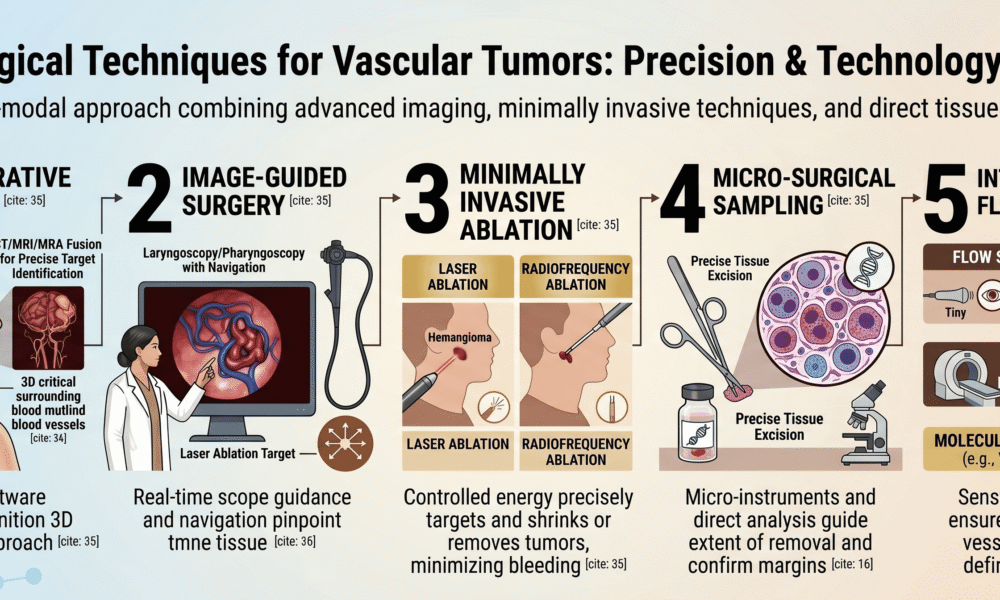
Laser-Assisted Surgical Techniques
Laser technology has become an important tool in the treatment of certain vascular tumors.
How Lasers Help
Lasers can:
- Precisely cut tissue
- Seal small blood vessels
- Reduce bleeding
- Preserve surrounding structures
Common Uses
- Superficial vascular lesions
- Oral vascular tumors
- Laryngeal vascular lesions
- Selected pediatric vascular tumors
Because lasers provide excellent control, they are particularly useful in delicate areas where conventional surgery may be challenging.
Image-Guided Navigation Surgery
Modern operating rooms increasingly use navigation systems similar to GPS technology.
How Surgical Navigation Works
Preoperative imaging is integrated into a computer-guided system that tracks surgical instruments in real time.
This helps surgeons:
- Locate tumor margins accurately
- Avoid critical structures
- Improve precision
- Reduce complications
Ideal Applications
- Skull base vascular tumors
- Deep facial lesions
- Complex head and neck vascular tumors
Navigation technology is especially beneficial when anatomy is distorted by the tumor.
Robotic-Assisted Surgery for Selected Vascular Tumors
Robotic surgery continues to expand in head and neck surgery.
What Is Robotic Surgery?
The surgeon controls robotic instruments that provide:
- High-definition visualization
- Tremor-free movement
- Exceptional precision
Potential Benefits
- Better access to difficult areas
- Smaller incisions
- Improved cosmetic outcomes
- Faster recovery
Although not suitable for every vascular tumor, robotic-assisted surgery can be valuable in carefully selected cases involving the throat and upper airway.
Microvascular Reconstruction After Tumor Removal
Removing large vascular tumors may leave significant tissue defects.
What Is Microvascular Reconstruction?
Microvascular reconstruction involves transferring tissue from another part of the body and reconnecting tiny blood vessels under a microscope.
Common donor sites include:
- Forearm
- Thigh
- Fibula (leg bone)
Benefits
- Restoration of appearance
- Preservation of swallowing
- Preservation of speech
- Improved quality of life
This technique has revolutionized the management of complex head and neck tumors requiring extensive resection.
Hybrid Approaches: Combining Multiple Techniques
Many patients benefit from a combination of treatments rather than surgery alone.
Examples include:
- Embolization followed by surgery
- Sclerotherapy followed by surgery
- Laser treatment plus surgical excision
- Reconstruction after tumor removal
These multidisciplinary approaches often provide the best long-term outcomes.
Enhanced Recovery After Surgery (ERAS)
Modern surgical care extends beyond the operating room.
Enhanced Recovery After Surgery (ERAS) protocols help patients recover faster through:
- Better pain management
- Early mobilization
- Optimized nutrition
- Reduced hospital stay
These evidence-based pathways have improved both safety and patient satisfaction.
What Patients Can Expect After Modern Vascular Tumor Surgery
Recovery depends on:
- Tumor size
- Location
- Surgical complexity
- Overall health
Many patients experience:
- Less postoperative pain
- Smaller scars
- Shorter hospitalization
- Faster return to normal activities
Regular follow-up remains important to monitor healing and detect recurrence if it occurs.
Choosing the Right Surgical Team Matters
Vascular tumors can involve complex anatomy and significant blood supply. Successful treatment often requires collaboration between:
- Head and neck surgeons
- Vascular surgeons
- Interventional radiologists
- Reconstructive surgeons
- Anesthesiologists
Treatment at a center experienced in vascular tumor management can significantly improve outcomes.
Final Thoughts
The treatment of vascular tumors has advanced dramatically in recent years. Modern techniques such as preoperative embolization, microsurgery, endoscopic surgery, laser-assisted procedures, image-guided navigation, robotic surgery, and microvascular reconstruction have made surgery safer and more effective than ever before.
Not every vascular tumor requires surgery, but when surgical treatment is necessary, today’s technology allows surgeons to achieve excellent functional, cosmetic, and oncological outcomes.
If you have been diagnosed with a vascular tumor, a thorough evaluation by an experienced specialist can help determine the most appropriate treatment approach and whether modern surgical techniques may benefit your specific condition.
About the Author
Dr. Dushyant Mandlik is a highly experienced Head & Neck Cancer Surgeon in Ahmedabad with expertise in the diagnosis and surgical management of complex head and neck conditions, including oral cancer, thyroid cancer, salivary gland tumors, vascular tumors, and skull base lesions. He specializes in advanced surgical techniques such as microvascular reconstruction, minimally invasive surgery, robotic-assisted procedures, and organ-preserving cancer treatment.
With extensive experience in managing both benign and malignant tumors of the head and neck region, Dr. Mandlik is committed to delivering evidence-based, patient-centered care. His clinical approach focuses not only on successful tumor removal but also on preserving essential functions such as speech, swallowing, breathing, and appearance to ensure the best possible quality of life for patients.
Through his educational articles and patient awareness initiatives, Dr. Mandlik aims to help individuals recognize early warning signs of head and neck diseases, understand modern treatment options, and make informed healthcare decisions.