Cancer surgery has always demanded a delicate balance between completely removing the tumor and preserving vital structures such as nerves, blood vessels, and organs. In head and neck cancers, this challenge becomes even more complex due to the dense and intricate anatomy.
Today, 3D technology is redefining how we plan, perform, and optimize cancer surgery, bringing a new level of precision, safety, and predictability to patient care.
Understanding 3D Technology in Cancer Surgery
3D technology in surgery primarily involves:
- 3D imaging and reconstruction from CT/MRI scans
- Virtual surgical planning (VSP)
- 3D printing of patient-specific anatomical models
- Custom surgical guides and implants
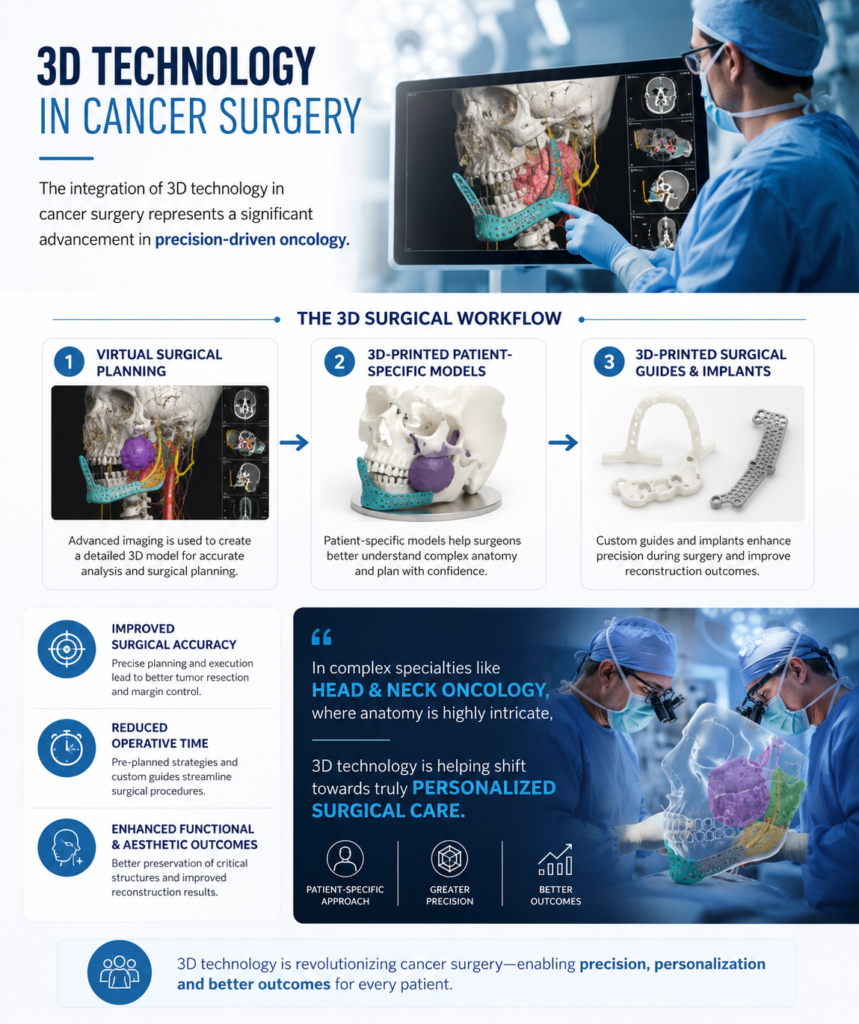
These technologies allow surgeons to move from a “one-size-fits-all” approach to highly personalized, patient-specific surgery.
1. Enhanced Preoperative Planning
Traditionally, surgeons relied on 2D scans to interpret complex anatomy. With 3D reconstruction, we can now:
- Visualize tumors in relation to surrounding structures
- Understand the exact extent of disease
- Simulate surgery before entering the operating room
Studies show that 3D reconstruction significantly improves diagnostic accuracy and surgical precision while reducing operative time.
In practical terms, this means fewer surprises during surgery and better outcomes for patients.
2. 3D-Printed Models: “Holding the Tumor in Hand”
One of the most powerful innovations is the ability to print a 3D model of the patient’s anatomy, including the tumor.
This allows surgeons to:
- Physically study complex tumors before surgery
- Plan exact surgical margins
- Rehearse difficult procedures
As highlighted in advanced surgical centers, having a 3D model helps surgeons fully understand anatomy that may not be completely visible on imaging alone.
For patients, this also improves communication – they can actually see and understand their condition.
3. Precision Surgery with Custom Surgical Guides
3D technology enables the creation of patient-specific cutting guides, which:
- Define exact angles and depths of surgical cuts
- Improve accuracy in tumor removal
- Ensure safe margins while preserving vital structures
In complex head and neck surgeries, these guides can reduce operating time significantly and improve surgical outcomes.
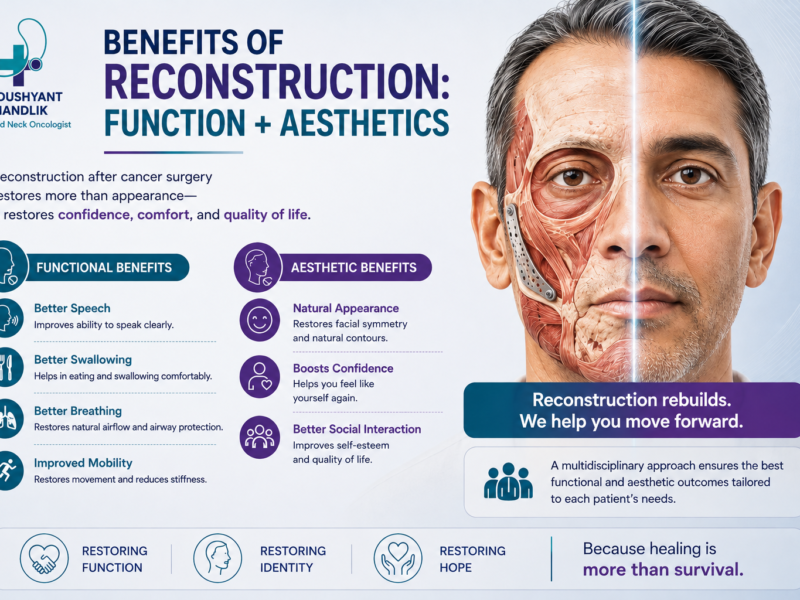
4. Revolutionizing Reconstruction After Cancer Removal
Cancer surgery is not just about removing the tumor it is also about restoring:
- Function (speech, swallowing, breathing)
- Appearance (facial symmetry, jaw structure)
Using 3D technology, we can:
- Design custom jaw reconstructions
- Plan bone grafts with millimeter precision
- Create patient-specific titanium plates
This results in:
- Better functional recovery
- Improved cosmetic outcomes
- Lower risk of complications such as implant failure
5. Reduced Surgical Time and Faster Recovery
3D planning and guides streamline the surgical workflow, leading to:
- Shorter operation time (sometimes reduced by hours)
- Less anesthesia exposure
- Lower risk of complications
Advanced centers report that 3D-assisted planning can save up to 2 hours in surgery, directly benefiting patient safety.
6. Integration with AR, VR, and Future Technologies
The future of cancer surgery is even more exciting with:
- Augmented Reality (AR) for real-time tumor visualization
- Virtual Reality (VR) for surgical simulation
- Bioprinting for tissue and organ reconstruction
In India itself, surgeons are already using AR with 3D models to perform highly precise cancer surgeries with minimal incisions and better cosmetic outcomes.
7. Personalized Cancer Care: The Biggest Advantage
Perhaps the most important impact of 3D technology is personalization.
Every cancer is unique and now, every surgery can be tailored to:
- The patient’s exact anatomy
- Tumor size and spread
- Functional and cosmetic needs
This represents a shift from conventional surgery to precision oncology.
Challenges and Limitations
While 3D technology offers immense advantages, it also comes with considerations:
- Cost and accessibility
- Need for specialized infrastructure
- Requirement of multidisciplinary collaboration (surgeons, radiologists, engineers)
However, as technology advances, these barriers are rapidly decreasing.
Conclusion
3D technology is not just an innovation, it is a paradigm shift in cancer surgery.
From better planning and precision to improved reconstruction and recovery, it is transforming outcomes for patients, especially in complex fields like head and neck oncology.
As a cancer surgeon, adopting these technologies allows us to deliver:
- Safer surgeries
- Better functional outcomes
- Improved quality of life
The future of cancer care is precise, personalized, and technology-driven, and 3D technology is at the forefront of this revolution.
Dr. Dushyant Mandlik one of best head & neck cancer surgeon in ahmedabad specializing in advanced cancer surgery, microvascular reconstruction, and technology-driven precision oncology.