When a patient develops a persistent mouth ulcer, an unusual lump in the neck, difficulty swallowing or an unexplained growth, one of the first concerns is whether it could be cancer.
Clinical examination and imaging investigations help identify suspicious abnormalities. However, they cannot always determine whether a growth is cancerous or non-cancerous. This is where biopsy plays a crucial role in cancer detection.
A biopsy allows doctors to obtain a sample of cells or tissue from a suspicious area and examine it under a microscope. It helps establish an accurate diagnosis and provides important information for planning further treatment.
As a head and neck cancer surgeon with over 20 years of experience, I consider biopsy an essential part of evaluating many suspicious head and neck lesions. Understanding why it is performed and what patients can expect can help reduce unnecessary anxiety.
What Is a Biopsy?
A biopsy is a medical procedure in which a small sample of tissue or cells is collected from an abnormal area for laboratory examination.
The sample is examined by a pathologist, a specialist trained to identify diseases by studying cells and tissues under a microscope.
The examination helps determine whether the abnormality is:
- Benign (non-cancerous)
- Malignant (cancerous)
- Premalignant or dysplastic (showing abnormal cellular changes that may carry a risk of developing into cancer)
If cancer is confirmed, the pathology examination can also help identify its type and other characteristics relevant to treatment planning.
In many suspected solid cancers, biopsy is the most reliable way to establish a definitive diagnosis. [1]
Why Is Biopsy Important in Cancer Detection?
A lump, ulcer or abnormal growth does not automatically mean cancer. Several non-cancerous conditions, including infections, inflammation and benign growths, can produce similar symptoms.
A biopsy helps distinguish between these conditions.
Its importance includes:
1. Confirming or ruling out cancer: A tissue sample helps establish whether cancer cells are present in the suspicious area.
2. Identifying the cancer type: Different cancers can develop in the same anatomical region. Histopathological examination helps identify the specific type of tumour.
3. Understanding abnormal cellular changes: Biopsy can identify dysplasia and certain precancerous changes that may require monitoring or treatment.
4. Supporting treatment decisions: The diagnosis and tumour characteristics help doctors determine the appropriate treatment approach, which may involve surgery, radiation therapy, systemic treatment or a combination.
5. Avoiding unnecessary treatment: When a suspicious lesion is found to be non-cancerous, the patient can be guided towards appropriate management rather than cancer treatment.
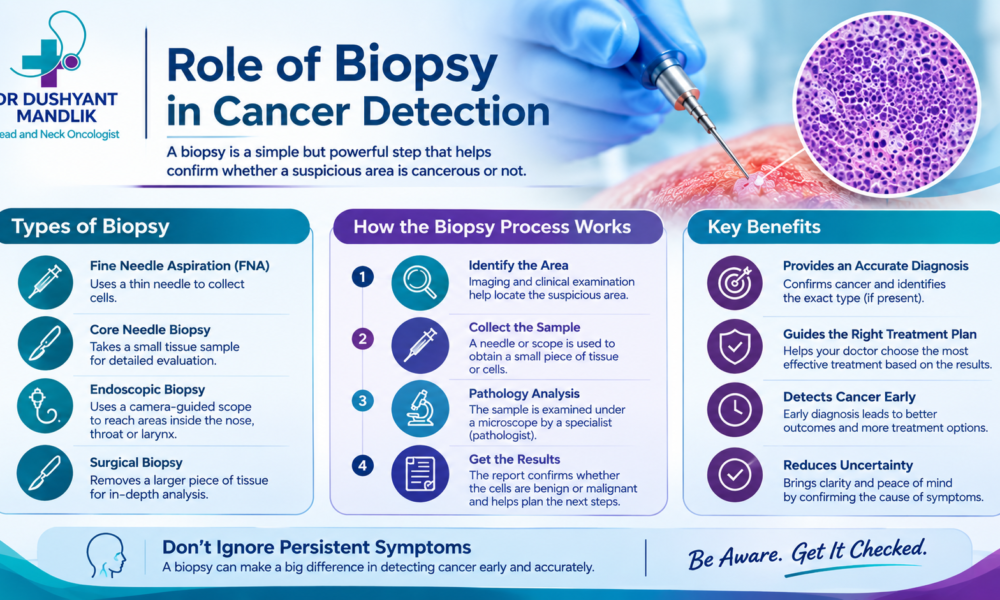
Different Types of Biopsy Used in Head & Neck Cancer
The biopsy technique depends on the location, size and nature of the suspicious abnormality.
1. Incisional Biopsy
In an incisional biopsy, the doctor removes a small portion of the suspicious lesion for examination.
It is commonly used when a growth is relatively large and removing the entire lesion at the diagnostic stage is not appropriate.
For example, a suspicious ulcer on the tongue or inner cheek may require an incisional biopsy.
2. Excisional Biopsy
An excisional biopsy involves removing the entire suspicious lesion for laboratory examination.
It may be considered for selected small lesions when complete removal is appropriate.
The decision depends on the lesion’s location, size and clinical assessment.
3. Fine Needle Aspiration Cytology (FNAC)
Fine needle aspiration uses a thin needle to collect cells or fluid from a suspicious lump.
In head and neck cancer evaluation, FNAC is commonly used for enlarged neck lymph nodes, thyroid nodules and certain other swellings.
The collected cells are examined under a microscope.
FNAC is useful because it is generally a relatively simple procedure. However, it provides individual cells rather than the complete tissue architecture, and sometimes additional testing is necessary.
4. Core Needle Biopsy
A core needle biopsy uses a wider needle to obtain a small cylindrical sample of tissue.
Unlike FNAC, it provides tissue architecture, which can offer additional diagnostic information.
It may be recommended for selected neck masses or other suspicious lesions, sometimes with ultrasound or CT guidance.
5. Endoscopic Biopsy
Some abnormalities develop in areas that cannot be examined adequately through a routine oral examination.
These may include the voice box, throat, nasal cavity or other deeper structures.
In such situations, an endoscope helps the surgeon visualise the affected area and obtain a tissue sample.
Depending on the location, the procedure may be performed under local or general anaesthesia.
What Happens During a Biopsy?
The exact procedure depends on the area being examined.
For an accessible oral lesion, the doctor may first apply local anaesthesia to numb the area. A small tissue sample is then collected using an appropriate instrument.
For deeper lesions, the patient may require an endoscopic procedure under anaesthesia.
A needle biopsy of a neck lump may be performed with or without imaging guidance, depending on the clinical situation.
After collection, the sample is preserved and sent to a pathology laboratory for examination.
Most patients can return home after a minor biopsy, although recovery instructions vary according to the procedure.
What Does a Biopsy Report Tell Us?
The pathology report is an important document in cancer diagnosis.
It may provide information about:
- Whether cancer is present
- The type of tumour
- The cellular characteristics of the abnormality
- The degree of differentiation or tumour grade, when applicable
- Additional findings that may require specialised testing
In certain cancers, additional investigations such as immunohistochemistry or molecular testing may be recommended.
These tests can help clarify the tumour’s origin or identify biological markers that may influence treatment decisions.
The report is interpreted alongside the clinical examination and imaging findings. A biopsy result should not be considered in isolation.
Does Every Suspicious Lump Require a Biopsy?
Not necessarily. The need for biopsy depends on the patient’s symptoms, examination findings, imaging results and the nature of the suspected abnormality.
Some lesions may initially require observation or treatment for an identified non-cancerous condition. Others need prompt tissue diagnosis.
For example, a persistent mouth ulcer, suspicious white or red patch, unexplained neck lump or abnormal growth may require further investigation.
The important point is to avoid repeatedly treating a suspicious lesion without establishing its cause.
Why Is Biopsy Important Before Cancer Treatment?
Cancer treatment must be based on an accurate diagnosis.
A patient with a suspicious oral lesion may require surgery, radiation therapy or other treatment depending on the final diagnosis and disease extent.
Without appropriate diagnostic confirmation, selecting the right treatment becomes difficult.
For patients seeking specialised evaluation, an experienced head and neck cancer surgeon in Ahmedabad can help coordinate clinical examination, biopsy and further investigations to establish an accurate diagnosis.
Once cancer is confirmed, additional imaging and staging investigations help determine the extent of the disease and guide treatment planning.
Is Biopsy Painful? Are There Any Risks?
Many patients feel anxious before undergoing a biopsy, particularly when they are worried about the possibility of cancer.
Most minor biopsies are performed using local anaesthesia, which helps minimise discomfort.
Temporary soreness, mild bleeding or swelling may occur depending on the procedure. Deeper biopsies may require anaesthesia and have different recovery considerations.
Patients should inform their doctor about existing medical conditions and medications, particularly blood-thinning medicines, before the procedure.
It is also important to follow the specific aftercare instructions provided by the treating team.
Final Thoughts: Accurate Diagnosis Is the First Step Towards Appropriate Treatment
A biopsy is much more than a routine diagnostic procedure. It provides essential information that helps doctors understand the nature of a suspicious lesion and make informed treatment decisions.
In head and neck oncology, timely and accurate tissue diagnosis is particularly important because these cancers can affect vital functions such as speech, swallowing, breathing and eating.
My advice to patients is simple: do not ignore persistent symptoms, unexplained lumps or unusual changes in the mouth, throat or neck. Seek appropriate medical evaluation rather than delaying diagnosis.
The right treatment begins with the right diagnosis. A properly planned biopsy can be an important first step towards effective cancer care.