A lump, swelling, or bluish discoloration on the face, neck, tongue, or inside the mouth can be concerning for patients and parents alike. One of the common questions I hear in my practice is: “Is this a tumor? Is it cancer?”
The good news is that many vascular lesions are benign (non-cancerous). However, understanding the difference between vascular tumors and vascular malformations is important because their behavior, treatment, and long-term outcomes can vary significantly.
In this article, I explain vascular tumors in simple terms, including hemangiomas, vascular malformations, their symptoms, diagnosis, and treatment options.
What Are Vascular Tumors?
Vascular tumors are abnormal growths that develop from blood vessels or lymphatic vessels.
They occur when cells that form blood vessels grow excessively, creating a mass or swelling.
Most vascular tumors are benign, but they can sometimes:
- Grow rapidly
- Cause cosmetic concerns
- Interfere with breathing, swallowing, or speech
- Bleed repeatedly
- Affect nearby structures
These lesions can occur anywhere in the body but are commonly seen in:
- Face
- Lips
- Tongue
- Oral cavity
- Neck
- Scalp
- Skin
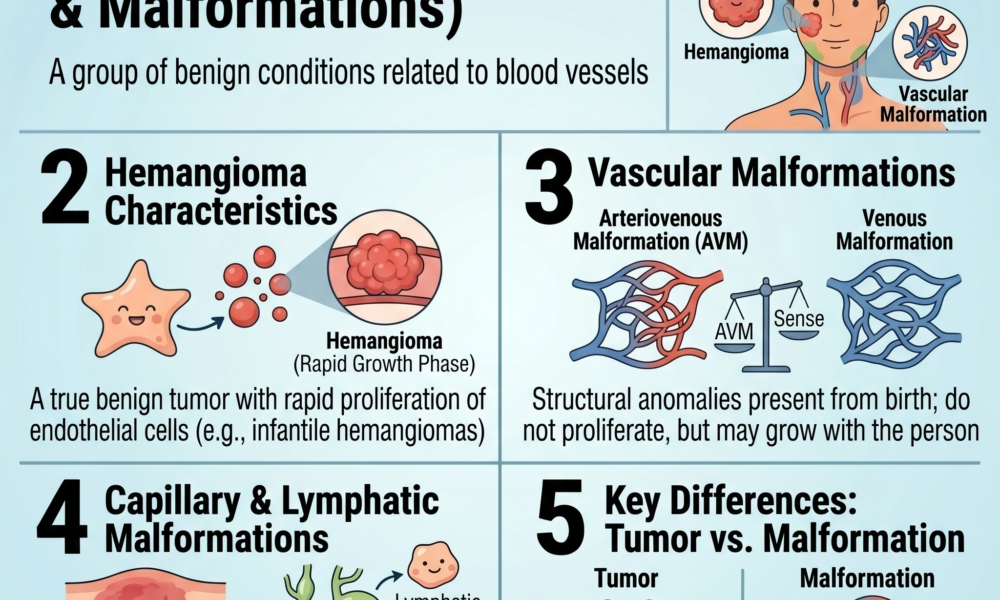
Vascular Tumors vs. Vascular Malformations: What’s the Difference?
Many people use these terms interchangeably, but they are different conditions.
Vascular Tumors
These involve abnormal growth of blood vessel cells.
Characteristics:
- Usually appear after birth or in early infancy
- Grow during a specific phase
- May shrink over time
- Have active cell proliferation
The most common example is a hemangioma.
Vascular Malformations
These are abnormally formed blood vessels present from birth.
Characteristics:
- Present at birth, although they may not be obvious initially
- Grow proportionately with the child
- Do not disappear on their own
- Often enlarge over time
Treatment approaches differ significantly from vascular tumors.
What Is a Hemangioma?
A hemangioma is the most common benign vascular tumor seen in infants.
Often called a “strawberry birthmark,” it results from an overgrowth of blood vessel cells.
How Do Hemangiomas Develop?
Typically, they follow three phases:
1. Growth Phase
The lesion enlarges rapidly during the first few months of life.
2. Stabilization Phase
Growth slows and eventually stops.
3. Involution Phase
Many hemangiomas gradually shrink over several years.
Some may disappear almost completely, while others leave residual skin changes.
What Does a Hemangioma Look Like?
Appearance depends on depth and location.
Common features include:
- Bright red raised lesion on the skin
- Soft swelling
- Bluish discoloration if deeper
- Painless mass in most cases
Some occur inside the mouth, tongue, or airway.
When Can Hemangiomas Become a Problem?
Most hemangiomas are harmless and only require observation.
However, treatment may be necessary if they:
- Obstruct vision
- Affect breathing
- Interfere with feeding
- Cause recurrent bleeding
- Become ulcerated
- Create significant cosmetic deformity
Early evaluation is important in such situations.
What Are Vascular Malformations?
Unlike hemangiomas, vascular malformations are structural abnormalities of blood vessels.
They are present from birth but may become noticeable later in life.
These lesions do not go through a growth-and-shrink cycle.
Instead, they tend to persist and gradually enlarge.
Types of Vascular Malformations
Venous Malformations
These involve abnormal veins.
Symptoms may include:
- Soft bluish swelling
- Enlargement during crying or straining
- Discomfort
- Cosmetic concerns
Venous malformations frequently affect the face, lips, tongue, and neck.
Lymphatic Malformations
These involve abnormalities of the lymphatic system.
Features include:
- Soft cystic swelling
- Neck masses
- Recurrent infections
- Enlargement after illness
Many are diagnosed during childhood.
Arteriovenous Malformations (AVMs)
These are more complex lesions involving direct connections between arteries and veins.
Symptoms may include:
- Pulsating swelling
- Warm skin over the lesion
- Bleeding
- Pain
- Progressive enlargement
AVMs often require specialized management.
Capillary Malformations
These affect small blood vessels near the skin surface.
A common example is a port-wine stain.
These lesions usually appear as:
- Flat pink patches
- Red discoloration
- Darkening over time
Are Vascular Tumors Cancerous?
The vast majority of vascular tumors encountered in clinical practice are benign.
However, some rare vascular tumors can be malignant.
Because appearance alone is not always sufficient for diagnosis, specialist evaluation is recommended for any persistent or enlarging vascular lesion.
What Symptoms Should Prompt Medical Attention?
You should seek evaluation if a vascular lesion:
- Is growing rapidly
- Causes pain
- Bleeds repeatedly
- Interferes with swallowing
- Causes breathing difficulty
- Affects speech
- Becomes infected
- Produces facial asymmetry
Early diagnosis often makes treatment simpler and more effective.
How Are Vascular Tumors Diagnosed?
Diagnosis usually begins with a detailed clinical examination.
The lesion’s:
- Size
- Color
- Consistency
- Location
- Growth pattern
provide important clues.
Ultrasound with Doppler
Often the first imaging test.
It helps determine:
- Blood flow characteristics
- Type of vascular lesion
- Depth of involvement
MRI Scan
MRI is particularly useful for:
- Large lesions
- Deep lesions
- Head and neck vascular abnormalities
- Surgical planning
It provides detailed information about the lesion’s extent.
CT Scan
Sometimes used when bone involvement or complex anatomy needs evaluation.
Biopsy
A biopsy is not always required.
Because vascular lesions can bleed significantly, biopsy decisions should be made carefully by experienced specialists.
How Are Vascular Tumors Treated?
Treatment depends on:
- Type of lesion
- Size
- Symptoms
- Location
- Growth pattern
Not all vascular tumors require intervention.
Observation
Many infantile hemangiomas shrink naturally and only require monitoring.
Medication
Certain hemangiomas respond well to medications that slow growth and promote regression.
Sclerotherapy
A special solution is injected into the lesion to reduce its size.
Commonly used for:
- Venous malformations
- Some lymphatic malformations
Laser Therapy
Useful for selected superficial vascular lesions.
Surgery
Surgery may be recommended when lesions:
- Cause functional problems
- Bleed repeatedly
- Persist despite other treatments
- Produce cosmetic deformity
- Compress vital structures
Careful surgical planning is especially important in the head and neck region.
Why Specialist Evaluation Matters
The treatment for a hemangioma is very different from the treatment for a venous malformation or an arteriovenous malformation.
An accurate diagnosis helps determine:
- Whether treatment is necessary
- Which treatment is most appropriate
- Expected outcomes
- Risk of recurrence
This is why vascular lesions should ideally be assessed by specialists experienced in head and neck conditions and vascular anomalies.
Final Thoughts
Vascular tumors and vascular malformations are common causes of abnormal swellings involving the face, mouth, tongue, and neck. While most are benign, they can sometimes affect appearance, speech, swallowing, breathing, or quality of life.
Understanding whether a lesion is a hemangioma, venous malformation, lymphatic malformation, or another vascular anomaly is the first step toward effective treatment. Modern imaging and specialized treatment options allow many patients to achieve excellent functional and cosmetic outcomes.
If you notice a persistent vascular swelling, recurring bleeding lesion, or unexplained mass in the head and neck region, early specialist evaluation can help ensure the correct diagnosis and management plan.
About the Oncologist
Dr. Dushyant Mandlik is a head & neck cancer surgeon in ahmedabad with expertise in managing complex tumors and vascular lesions involving the face, oral cavity, neck, thyroid, and salivary glands. His approach combines accurate diagnosis, advanced surgical techniques, and patient-centered care to achieve the best possible outcomes.